This time I would like to write in English also to reach my English speaking students 🙂
Every time when a new course starts, I often get the same question:
“What is the correct way to write sa さ, ki き, so そ, fu ふ ?”
Here is my answer.
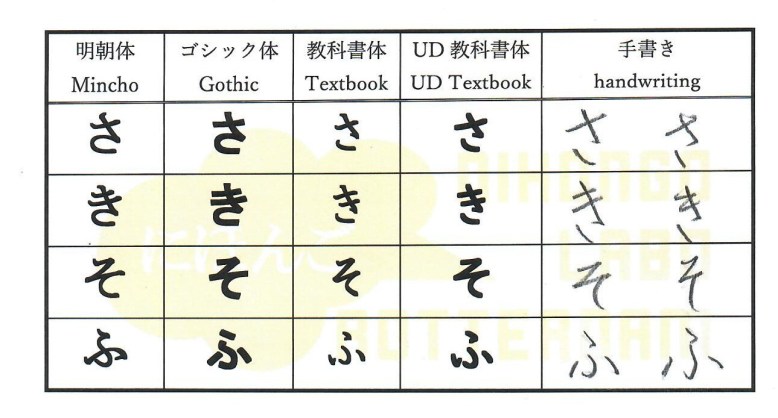
There is no absolute one and only correct style, but there is a common way of handwriting that most Japanese learn from their childhood, and that is 楷書体 かいしょたい Kaisho-tai handwriting style. 楷書体 かいしょたい Kaisho-tai is the most rigid, easy to read writing style. And we have 行書体 Gyousho-tai and 草書体 Sousho-tai, which you can compare to cursive hand writing. You’ll see Gyousho-tai and Sousho-tai in classic handwritten scripts, but we don’t learn them anymore at school. You have to follow calligraphy course or special courses to be able to write and read.
The typeface Japanese children first encounter is probably 教科書体 きょうかしょたい Kyoukasho-tai (textbook style) , which is used for most of our school textbooks, and closest to 楷書体 かいしょたい Kaisho-tai handwriting style.
Recently we see more and more UD教科書体 UD (=Universal Design) textbook style. This was developed based on existing Kyoukasho-tai, but thin lines were made thicker to be more visible and recognizable for people with learning difficulties.
Can you see the difference between normal and UD Kyoukasho-tai and the other two typefaces?
The second and third strokes of sa and ki are detached with Kyoukasho-tai, and with Mincho and Gothic they are connected. Either way is OK, BUT how we learn at Japanese school with pencil is two lines detached.
If you learn Japanese calligraphy, and you learn cursive Gyousho-style, these two lines would be again connected. It’s a single flow of stroke. It’s a matter of how hard or light u push your brush against the paper.
I think you all have your favourite typefaces in alphabet. Some people like Gothic, other people like Times New Roman. Contents matter, but there are images that typefaces represents. Just like you never use Comic Sans for your serious business presentation.
Well… I see quite often that Japanese textbooks published in foreign countries are using Gothic fonts for Hiragana, Katakana, and Kanji. There is nothing wrong with that as long as contents are great, but it makes me itchy, especially when I see textbooks using MS Gothic. It seems so…. so outdated and uncool.
If you have any questions or comments, please let me hear from you!
Fumiko-sensei
 NIHONGO LABO ROTTERDAM